

SCIENCE • INTERVIEW • ANALYTICAL CHEMISTRY
Inside the UCL School of Pharmacy’s NMR facility, Haider Hussain explains how nuclear spins reveal molecular behaviour—and what must happen before NMR-based metabolomics becomes part of routine clinical care.
By Dr Pınar Şengül | London | August 2026
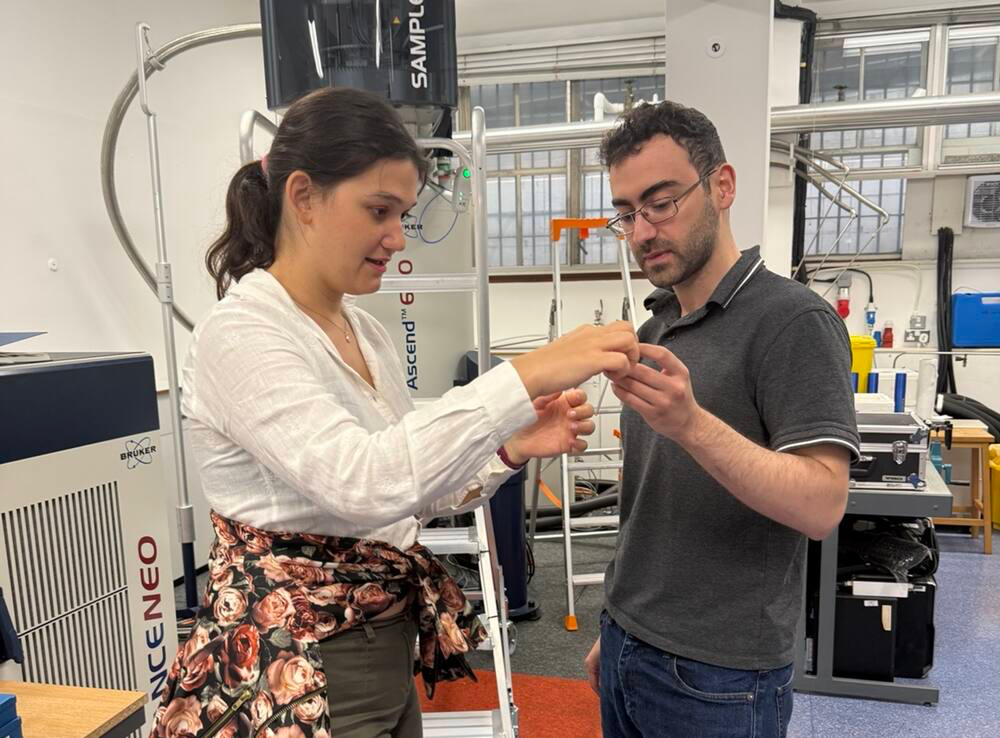
In a laboratory at the UCL School of Pharmacy, a slim glass tube can become a window onto molecular behaviour. The sample itself may appear unremarkable. Inside a nuclear magnetic resonance spectrometer, however, atomic nuclei respond to an intense magnetic field and radiofrequency energy, producing signals that can reveal structure, interactions and motion. The resulting spectrum is not simply a molecular inventory. Read carefully, it is a record of what molecules are doing.
That distinction matters to Haider Hussain, the facility’s NMR Facility Manager. For him, nuclear magnetic resonance is compelling precisely because it refuses to fit into a single scientific box. It brings together physics, mathematics, computing, chemistry, hands-on instrumentation and applications capable of improving human health.
A scientific language built from spin
Hussain entered the field through pharmaceutical sciences. After an MPharm at the University of East Anglia, his master’s research used solid-state NMR to characterise cellulose hydrogels and hemicellulose composites. His doctoral work then focused on developing chemical-shift imaging methods to study molecular interactions relevant to drug delivery and biomaterials. Managing an NMR facility became a natural way to remain involved in the full breadth of the discipline.
To explain the underlying physics, Hussain begins with spin. Many atomic nuclei possess this quantum property and behave, in a simplified analogy, like tiny magnets. In a strong magnetic field, slightly more nuclei align with the field than against it. A radiofrequency pulse provides energy and pushes some nuclei into a higher-energy state. As they relax, they emit signals whose frequencies depend on both the nucleus and its local chemical environment.
“Rather than simply asking what molecules are present, NMR helps us understand what those molecules are actually doing.”
Haider Hussain
Because chemically distinct environments generate distinguishable signals, researchers can build detailed pictures of molecular structure and behaviour. NMR is non-destructive, is not limited by crystal-lattice constraints and can probe processes across broad timescales. In biomedical research, those characteristics support metabolite identification and quantification, structural studies, protein-interaction analysis, drug-binding experiments and investigations of molecular dynamics.
One instrument, many scientific questions
The projects moving through the UCL facility reflect this range. Hussain and his colleagues support researchers developing pharmaceuticals, studying protein–ligand interactions, analysing natural products, investigating metabolic pathways and characterising polymers and biomaterials. The facility also works with industry and provides analytical services to external organisations.
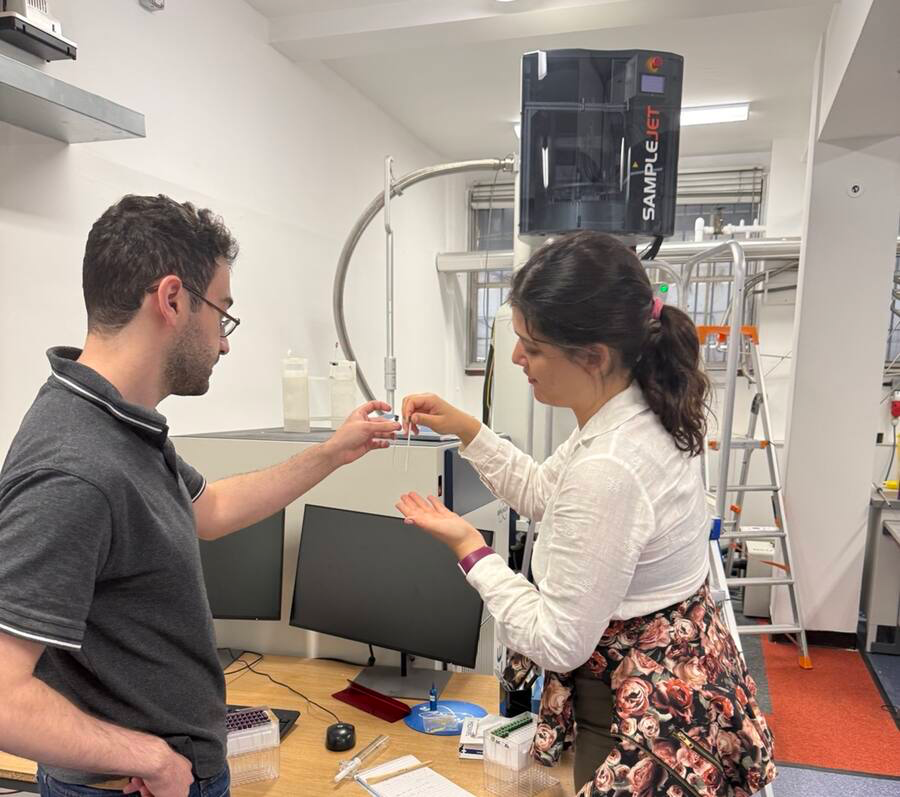
Yet access to sophisticated hardware can create a misleading sense of simplicity. Even a routine spectrum is produced through an adjustable chain of experimental parameters, pulse sequences, acquisition choices and processing operations. Hussain sees incomplete awareness of this chain as one of the field’s persistent problems. A standard protocol may be appropriate in one context and inadequate in another; the experimental design must follow the scientific question.
This is why his central lesson for young researchers is conceptual rather than procedural: NMR is not a single technique but a family of techniques united by the use of nuclear spins and their interaction with an external magnetic field. Once a researcher defines what they need to learn from a sample, the appropriate NMR experiment becomes much easier to select.
NMR or mass spectrometry? The wrong question
In metabolomics, discussions often frame NMR and mass spectrometry as competitors. Hussain rejects that binary. Mass spectrometry offers extraordinary sensitivity and can detect compounds at extremely low concentrations, making it a powerful starting point when the aim is broad metabolite discovery. NMR offers a different set of strengths: highly reproducible quantitative measurements, minimal sample preparation, rich structural information and the ability to study intact samples and molecular interactions.
The analytical choice therefore depends on purpose. For absolute quantification, structural confirmation, long-term reproducibility or interaction studies, NMR may provide decisive advantages. For maximum coverage of low-abundance metabolites, mass spectrometry is often stronger. The most informative metabolomics programmes increasingly combine them, using orthogonal evidence to compensate for the limitations of either platform alone.
Stronger magnets—and more sustainable laboratories
Several technological developments are expanding what NMR can do. Higher magnetic fields and improved cryoprobes continue to raise sensitivity and resolution. Hyperpolarisation could help address one of NMR’s most familiar limitations by dramatically increasing signal intensity, while pure-shift experiments can simplify crowded spectra and improve resolution. At the other end of the scale, benchtop instruments are making NMR accessible outside specialist high-field facilities.
For a facility manager, progress is not measured only in spectral performance. High-field NMR relies on costly cryogens, and advances in helium and nitrogen recycling can reduce both operating costs and environmental burden. As research facilities grow, Hussain believes this infrastructure will become increasingly important. The future of NMR will be shaped not only by what instruments can detect, but also by whether laboratories can operate them sustainably.
The long road from spectra to clinical decisions
NMR-based metabolomics already produces detailed and reproducible biomedical data. That does not mean it is ready to become an ordinary part of clinical care. Hussain identifies standardisation as the largest remaining barrier: clinical laboratories require harmonised sample preparation, reproducible protocols, consistent instrument calibration and validated analysis pipelines.
The second barrier is interpretability. A complex metabolic pattern becomes clinically useful only when it can support a robust and actionable decision. Physicians need biomarkers that are understandable, validated across appropriate populations and backed by strong clinical evidence. In Hussain’s assessment, the technology is capable; the harder task is building the evidence base, infrastructure and quality systems required for routine adoption.
“The technology is already capable of producing high-quality data. The remaining challenge is building the evidence base and infrastructure needed for routine clinical adoption.”
Haider Hussain
Why artificial intelligence has not transformed NMR—yet
Artificial intelligence is often presented as the inevitable next layer of every analytical workflow. Its effect on NMR, however, has so far been less dramatic than Hussain expected. Some researchers use AI to narrow the range of experiments required when designing fragment-based screens, and automated approaches can assist with processing data from large biomolecules such as proteins. But the field has not yet experienced the sweeping transformation seen elsewhere.
One reason may be data. High-performing AI systems depend on large, well-curated and accessible datasets, while high-quality open NMR data remain comparatively limited. The bottleneck is therefore not simply algorithmic ingenuity. It is also the creation of interoperable datasets, agreed metadata standards and trustworthy reference resources. AI’s eventual contribution to NMR may depend as much on scientific data culture as on computing power.
A career built on questions
Working across research environments has shown Hussain that laboratories can perform ostensibly similar activities through different standard operating procedures and scientific habits. Multiple approaches can be fruitful, he says, provided their value is demonstrated by data. For international researchers hoping to establish themselves in London, his advice is direct: be proactive, bring energy, attend seminars, ask questions and form genuine professional relationships. Just as importantly, choose a line of research that matches both ability and curiosity—and that peers recognise as capable of producing meaningful inquiry.
Technical expertise alone is not enough. Hussain emphasises the courage to attempt unfamiliar work, the discipline to practise and study, the resilience to persist through setbacks and the openness required for teamwork. Looking back at his own doctoral years, he is pleased that he continued asking questions. A PhD, he recalls, can feel like one of the last stages at which asking is clearly expected; later academic roles may make a scientist feel responsible for supplying answers.
His corrective advice to his younger self would concern time. The consequences of delay in academia may not be immediately visible, but they are real. Curiosity and time management, in his account, are not opposing qualities. They are what allow scientific questions to become finished experiments.
Begin with the question
The glass tube in the laboratory is therefore only the beginning. A magnet may be stronger, a probe more sensitive and software more automated, but none of these improvements decides what a researcher truly needs to know. NMR’s power lies in its variety—and that variety creates a responsibility to choose carefully.
From pharmaceutical development and biomaterials to metabolic biomarkers, the field’s future will depend on matching experiments to questions, combining complementary analytical methods and building reproducible systems that can carry molecular information into clinical practice. The tiny magnets supply the signals. Scientists must still decide what those signals are being asked to reveal.
About the interview
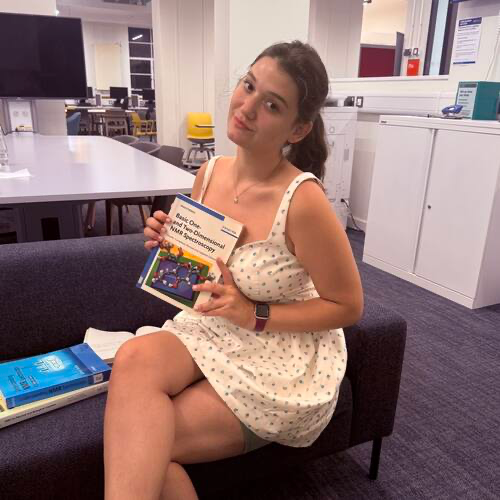
Pınar Şengül
Dr Pınar Şengül is a neuroscientist, neuropsychologist and science writer who has successfully completed her PhD viva. Her doctoral research uses ¹H-NMR metabolomics to investigate serum and cerebrospinal-fluid variation across oligoclonal-band patterns. Her work focuses on translating complex neuroscience and analytical chemistry into accessible scientific narratives.
This interview was conducted following an in-person visit to the UCL School of Pharmacy NMR Facility in London on 5 August 2026. Haider Hussain subsequently provided written responses to thirteen interview questions. Quotations have been lightly edited for grammar and clarity without changing their meaning.


