

From Tiny Magnets to Clinical Biomarkers: The Future of NMR

SCIENCE • INTERVIEW • ANALYTICAL CHEMISTRY

Inside the UCL School of Pharmacy’s NMR facility, Haider Hussain explains how nuclear spins reveal molecular behaviour—and what must happen before NMR-based metabolomics becomes part of routine clinical care.

By Dr Pınar Şengül | London | August 2026
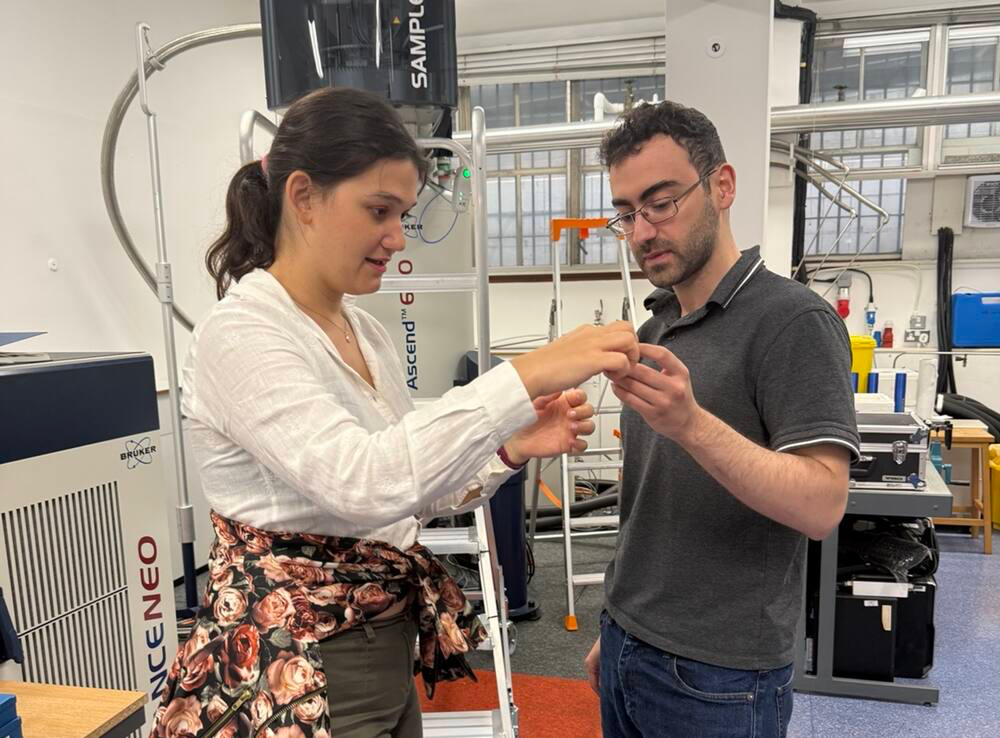
Dr Pınar Şengül and Dr Haider Hussain examining an NMR sample at the UCL School of Pharmacy NMR Facility.
Neuroscientist and science writer Dr Pınar Şengül examines an NMR sample with Dr Haider Hussain, NMR Facility Manager at the UCL School of Pharmacy, during a visit to the facility in London. Photograph courtesy of Pınar Şengül.

In a laboratory at the UCL School of Pharmacy, a slim glass tube can become a window onto molecular behaviour. The sample itself may appear unremarkable. Inside a nuclear magnetic resonance spectrometer, however, atomic nuclei respond to an intense magnetic field and radiofrequency energy, producing signals that can reveal structure, interactions and motion. The resulting spectrum is not simply a molecular inventory. Read carefully, it is a record of what molecules are doing.

That distinction matters to Haider Hussain, the facility’s NMR Facility Manager. For him, nuclear magnetic resonance is compelling precisely because it refuses to fit into a single scientific box. It brings together physics, mathematics, computing, chemistry, hands-on instrumentation and applications capable of improving human health.

A scientific language built from spin

Hussain entered the field through pharmaceutical sciences. After an MPharm at the University of East Anglia, his master’s research used solid-state NMR to characterise cellulose hydrogels and hemicellulose composites. His doctoral work then focused on developing chemical-shift imaging methods to study molecular interactions relevant to drug delivery and biomaterials. Managing an NMR facility became a natural way to remain involved in the full breadth of the discipline.

To explain the underlying physics, Hussain begins with spin. Many atomic nuclei possess this quantum property and behave, in a simplified analogy, like tiny magnets. In a strong magnetic field, slightly more nuclei align with the field than against it. A radiofrequency pulse provides energy and pushes some nuclei into a higher-energy state. As they relax, they emit signals whose frequencies depend on both the nucleus and its local chemical environment.

“Rather than simply asking what molecules are present, NMR helps us understand what those molecules are actually doing.”

Haider Hussain

Because chemically distinct environments generate distinguishable signals, researchers can build detailed pictures of molecular structure and behaviour. NMR is non-destructive, is not limited by crystal-lattice constraints and can probe processes across broad timescales. In biomedical research, those characteristics support metabolite identification and quantification, structural studies, protein-interaction analysis, drug-binding experiments and investigations of molecular dynamics.

One instrument, many scientific questions

The projects moving through the UCL facility reflect this range. Hussain and his colleagues support researchers developing pharmaceuticals, studying protein–ligand interactions, analysing natural products, investigating metabolic pathways and characterising polymers and biomaterials. The facility also works with industry and provides analytical services to external organisations.
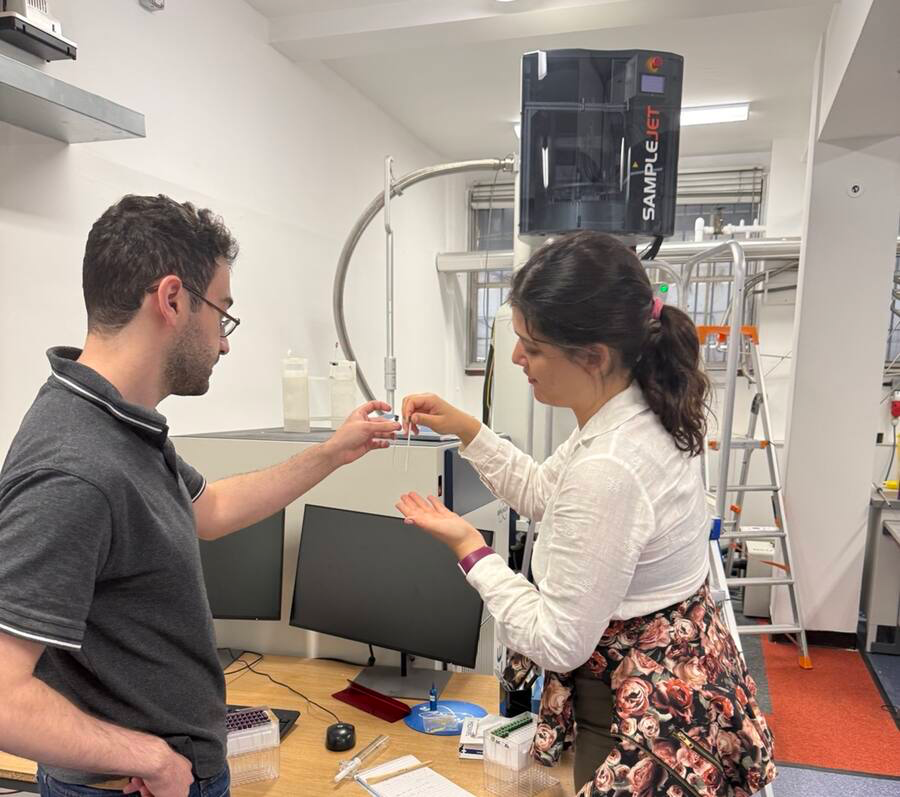
Dr Haider Hussain and Dr Pınar Şengül handling an NMR sample during a UCL facility visit.
Dr Haider Hussain and Dr Pınar Şengül handle an NMR sample during the facility visit. The choice of experiment, acquisition parameters and processing steps can substantially shape the resulting data. Photograph courtesy of Dr Pınar Şengül.

Yet access to sophisticated hardware can create a misleading sense of simplicity. Even a routine spectrum is produced through an adjustable chain of experimental parameters, pulse sequences, acquisition choices and processing operations. Hussain sees incomplete awareness of this chain as one of the field’s persistent problems. A standard protocol may be appropriate in one context and inadequate in another; the experimental design must follow the scientific question.

This is why his central lesson for young researchers is conceptual rather than procedural: NMR is not a single technique but a family of techniques united by the use of nuclear spins and their interaction with an external magnetic field. Once a researcher defines what they need to learn from a sample, the appropriate NMR experiment becomes much easier to select.

NMR or mass spectrometry? The wrong question

In metabolomics, discussions often frame NMR and mass spectrometry as competitors. Hussain rejects that binary. Mass spectrometry offers extraordinary sensitivity and can detect compounds at extremely low concentrations, making it a powerful starting point when the aim is broad metabolite discovery. NMR offers a different set of strengths: highly reproducible quantitative measurements, minimal sample preparation, rich structural information and the ability to study intact samples and molecular interactions.

The analytical choice therefore depends on purpose. For absolute quantification, structural confirmation, long-term reproducibility or interaction studies, NMR may provide decisive advantages. For maximum coverage of low-abundance metabolites, mass spectrometry is often stronger. The most informative metabolomics programmes increasingly combine them, using orthogonal evidence to compensate for the limitations of either platform alone.

Stronger magnets—and more sustainable laboratories

Several technological developments are expanding what NMR can do. Higher magnetic fields and improved cryoprobes continue to raise sensitivity and resolution. Hyperpolarisation could help address one of NMR’s most familiar limitations by dramatically increasing signal intensity, while pure-shift experiments can simplify crowded spectra and improve resolution. At the other end of the scale, benchtop instruments are making NMR accessible outside specialist high-field facilities.

For a facility manager, progress is not measured only in spectral performance. High-field NMR relies on costly cryogens, and advances in helium and nitrogen recycling can reduce both operating costs and environmental burden. As research facilities grow, Hussain believes this infrastructure will become increasingly important. The future of NMR will be shaped not only by what instruments can detect, but also by whether laboratories can operate them sustainably.

The long road from spectra to clinical decisions

NMR-based metabolomics already produces detailed and reproducible biomedical data. That does not mean it is ready to become an ordinary part of clinical care. Hussain identifies standardisation as the largest remaining barrier: clinical laboratories require harmonised sample preparation, reproducible protocols, consistent instrument calibration and validated analysis pipelines.

The second barrier is interpretability. A complex metabolic pattern becomes clinically useful only when it can support a robust and actionable decision. Physicians need biomarkers that are understandable, validated across appropriate populations and backed by strong clinical evidence. In Hussain’s assessment, the technology is capable; the harder task is building the evidence base, infrastructure and quality systems required for routine adoption.

“The technology is already capable of producing high-quality data. The remaining challenge is building the evidence base and infrastructure needed for routine clinical adoption.”

Haider Hussain

Why artificial intelligence has not transformed NMR—yet

Artificial intelligence is often presented as the inevitable next layer of every analytical workflow. Its effect on NMR, however, has so far been less dramatic than Hussain expected. Some researchers use AI to narrow the range of experiments required when designing fragment-based screens, and automated approaches can assist with processing data from large biomolecules such as proteins. But the field has not yet experienced the sweeping transformation seen elsewhere.

One reason may be data. High-performing AI systems depend on large, well-curated and accessible datasets, while high-quality open NMR data remain comparatively limited. The bottleneck is therefore not simply algorithmic ingenuity. It is also the creation of interoperable datasets, agreed metadata standards and trustworthy reference resources. AI’s eventual contribution to NMR may depend as much on scientific data culture as on computing power.

A career built on questions

Working across research environments has shown Hussain that laboratories can perform ostensibly similar activities through different standard operating procedures and scientific habits. Multiple approaches can be fruitful, he says, provided their value is demonstrated by data. For international researchers hoping to establish themselves in London, his advice is direct: be proactive, bring energy, attend seminars, ask questions and form genuine professional relationships. Just as importantly, choose a line of research that matches both ability and curiosity—and that peers recognise as capable of producing meaningful inquiry.

Technical expertise alone is not enough. Hussain emphasises the courage to attempt unfamiliar work, the discipline to practise and study, the resilience to persist through setbacks and the openness required for teamwork. Looking back at his own doctoral years, he is pleased that he continued asking questions. A PhD, he recalls, can feel like one of the last stages at which asking is clearly expected; later academic roles may make a scientist feel responsible for supplying answers.

His corrective advice to his younger self would concern time. The consequences of delay in academia may not be immediately visible, but they are real. Curiosity and time management, in his account, are not opposing qualities. They are what allow scientific questions to become finished experiments.

Begin with the question

The glass tube in the laboratory is therefore only the beginning. A magnet may be stronger, a probe more sensitive and software more automated, but none of these improvements decides what a researcher truly needs to know. NMR’s power lies in its variety—and that variety creates a responsibility to choose carefully.

From pharmaceutical development and biomaterials to metabolic biomarkers, the field’s future will depend on matching experiments to questions, combining complementary analytical methods and building reproducible systems that can carry molecular information into clinical practice. The tiny magnets supply the signals. Scientists must still decide what those signals are being asked to reveal.

About the interview

Dr Pınar Şengül holding a book in a laboratory.

Pınar Şengül

Dr Pınar Şengül is a neuroscientist, neuropsychologist and science writer who has successfully completed her PhD viva. Her doctoral research uses ¹H-NMR metabolomics to investigate serum and cerebrospinal-fluid variation across oligoclonal-band patterns. Her work focuses on translating complex neuroscience and analytical chemistry into accessible scientific narratives.

This interview was conducted following an in-person visit to the UCL School of Pharmacy NMR Facility in London on 5 August 2026. Haider Hussain subsequently provided written responses to thirteen interview questions. Quotations have been lightly edited for grammar and clarity without changing their meaning.

Why I Don’t Believe in the Title ‘Child and Adolescent Therapist’

It’s written everywhere—on clinic doors, websites, LinkedIn bios:
“Child and Adolescent Therapist.”

But as someone deeply committed to developmental neuroscience and therapeutic integrity, I’ll say this clearly:

Children and adolescents are not the same.
And pretending they are does a disservice to both.

The Brain Doesn’t Lie

A child’s brain and a teenager’s brain are not simply younger or older versions of each other. They are fundamentally different organisms in terms of structure, function, and regulation.

1. Myelination: Speed of Thought
In early childhood, the brain’s executive functions are still under construction. Myelination—the process that speeds up neural communication—is slow and uneven. Children live in the world of now, with limited foresight or inhibition. They don’t just need therapy; they need your nervous system as an anchor.

In adolescence, the emotional brain (limbic system) races ahead, while the prefrontal cortex (rational control) lags behind. This creates the infamous teenage turbulence: intense emotion with minimal regulation. Here, the therapist becomes a boundary-holder, not a co-regulator.

2. Synaptic Pruning: Jungle vs. Garden
Children’s brains are like a lush jungle—bursting with synaptic connections. They’re wide open, absorbing everything. Therapy must be sensory-rich, structured, and playful.

Teenagers, however, are pruning the excess. Their brains are streamlining—deciding who they are, what they care about, and what gets cut. Therapy here must honour identity exploration, autonomy, and cognitive sophistication. Clay and metaphor won’t reach a defended 16-year-old struggling with existential dread.

3. Limbic–Cortical Integration: Emotions vs. Reason
Children externalise emotion. Their regulation is social—dependent on attachment and sensory cues. Therapy must include the body, breath, symbol, and parent.

Adolescents internalise and intellectualise. They test boundaries. They want a witness, not a playmate. They need someone who won’t flinch at their rage, sarcasm, or silence.

The Therapist Must Choose

Of course, some clinicians do shift masterfully between child and adolescent work. But it’s rare. The posture, method, and energy required for each is distinct. Personally?

I am a co-regulator. I work best when I can meet a child in their emotional rawness, build symbolic bridges, and offer a nervous system steadier than their own.

Does that mean I don’t work with teens? Not necessarily. But it does mean I choose with intention—not branding.

Let’s Be Honest About Specialisation

The title “Child and Adolescent Therapist” may serve paperwork and marketing. But in practice, we owe our clients more precision. Children don’t need someone who tolerates play. They need someone who thrives in it. Adolescents don’t need someone who enjoys deep talk. They need someone who can survive the storm of separation and self-definition.

If we are to be ethically aligned with brain development, we must be willing to say:
“I specialise in children.”
or
“I specialise in adolescents.”
or
“I know where my skill ends—and I refer with respect beyond it.”


This is not about superiority. It’s about specificity. Children and adolescents are both sacred, sensitive stages. They deserve therapists who speak their language—neurologically, emotionally, and relationally.

Let’s stop selling ourselves short with generic titles.
Let’s claim who we truly serve—and serve them with everything we’ve got.

π

The Ethics of Eating Animals: A Neuroscientist’s Perspective

The meat, milk, and eggs we see on supermarket shelves and our tables every day hide the pain and suffering of billions of animals. Ignoring this reality means acting with a human-centered perspective and disrespecting the right to life of other living beings. As a neuroscientist and philosopher, I invite all sensitive individuals to think more deeply about this issue. In this article, I will go beyond anthropocentrism and discuss why we should defend animal rights. I will emphasize the moral value of animals through Joel Feinberg’s concept of “having interests” and Jainism’s principle of “ahimsa”. I will also address the debates on the sentience of plants, highlighting the difference between animal rights and plant rights.

Humans and Nature: A Historical Perspective

Throughout history, humanity has had a complex relationship with nature. Early humans, living in hunter-gatherer societies, were entirely dependent on nature . Natural resources were vital for food, shelter, and toolmaking . During this period, humans saw themselves as part of nature and lived in harmony with it . With the development of agriculture, humans began to shape nature according to their needs, creating a shift in the human-nature relationship . For example, about 4 million years ago, the Australopithecus species developed a skeletal structure that allowed them to adapt to changing humidity and vegetation . This adaptability was one of the first steps humans took towards altering and controlling their environment.  

The Industrial Revolution increased human dominance over nature, leading to environmental problems . Factories and mines polluted rivers and air, while deforestation caused widespread environmental damage . Today, issues like global warming, depletion of water resources, and biodiversity loss reveal the extent of human damage to nature . Since 1970, we have lost about 69% of the world’s biodiversity due to human settlements, agriculture, and industrial production . This makes the Earth’s life support systems more fragile . Human activities also support species that thrive in human-modified habitats, such as pigeons in cities, drug-resistant bacteria in hospitals, and grasses in urban environments .  

How did humans develop this domineering attitude towards nature? The answer lies in the different definitions of human nature and the factors influencing the human-nature relationship . Human nature can be defined in various ways, including innate abilities, tendencies and capacities, moral and ethical values, biological and genetic makeup, and cultural and social norms . Cultural values and beliefs, socioeconomic status, environmental factors, and personal experiences are among the important factors affecting the human-nature relationship . For example, while some cultures view nature as a spiritual or religious realm, others may perceive it as a resource to be exploited .  

We can also look at the human-nature relationship from different perspectives. Anthropocentrism believes that humans are superior to all other living beings and have the right to rule over them . This view has been used to justify the exploitation of natural resources and environmental destruction . Deep ecology, on the other hand, emphasizes the interconnectedness and intrinsic value of all living beings . Ecofeminism combines feminist and ecological ideas to challenge patriarchal domination and promote sustainable living practices . Biophilia argues that humans have an innate affinity for nature and other life forms .  

The Achuar people of Ecuador provide a different example of the human-nature relationship . The Achuar have a worldview called animism, which sees no separation between humans and nature and considers all living and non-living beings interconnected . Like many indigenous communities, the Achuar believe in the responsibility to respect and live in harmony with nature .  

The evolution of humanity’s relationship with nature has also shaped its interactions with other species. For example, the co-evolution of humans and dogs increased human survival chances . Dogs helped humans with hunting, protection, and companionship . This relationship demonstrates the human capacity for cooperation and learning from other species.  

At this point, the concepts of environmental ethics and animal ethics become crucial. Environmental ethics addresses human responsibilities towards nature, while animal ethics questions the moral status of non-human animals. Animal ethics debates have been addressed by different philosophical schools throughout history. In ancient Greek philosophy, Socrates examined the question of how humans should live best and emphasized the importance of reasoning . Aristotle argued that human reason is our most important characteristic and should be developed . Today, practices like industrial animal agriculture, animal experimentation, and habitat destruction make animal ethics discussions even more critical . Humans have become one of the greatest forces influencing the evolution of other organisms through activities like hunting, harvesting, fishing, agriculture, medicine, climate change, pollution, and urbanization .  

By examining the historical development of our relationship with nature, we can better understand our ethical responsibilities towards animals. Humans must acknowledge that they are not masters of nature but a part of it, and show respect for other living beings. This understanding forms the basis of animal rights discussions.

Animal Liberation and Peter Singer

Peter Singer is one of the first names that come to mind when discussing animal rights. A pioneer of the animal rights movement with his book “Animal Liberation”, Singer adopts the concept of preference utilitarianism. According to this view, moral actions are those that minimize pain and suffering and maximize happiness for all sentient beings. Singer emphasizes that animals, like humans, can feel pain and pleasure, and therefore their interests should also be considered . Singer’s principle of “equal consideration of interests for all sentient beings” provides a strong argument against speciesism. Speciesism is the discrimination against non-human animals based solely on their species. Singer equates speciesism with racism and sexism, arguing that it is morally unacceptable.  

Animal Rights and Philosophical Foundations

There are different philosophical approaches to animal rights. Rights-based approaches, like that of Tom Regan, argue that animals have inherent rights, while utilitarian approaches suggest that animal interests should be considered alongside human interests. The approach I want to focus on is Joel Feinberg’s concept of “having interests”. According to Feinberg, a being does not need to be conscious or feel pain to have interests. A being’s interests are things that matter to its well-being, and these interests can exist regardless of whether the being is conscious or not. For example, a tree needs water to grow and develop, and this water is in the tree’s interest. Even though the tree is not aware of this need, its interest still exists. Feinberg argues that animals, like humans, have interests, and these interests should be taken into account morally. As a neuroscientist, I agree with Feinberg’s view. My observation on animals confirms that they have complex emotional lives and rich social relationships. We know that they can experience emotions like pain, fear, joy, and sadness. Therefore, it is morally wrong to ignore their interests and use them solely for human needs.

Jainism offers an important perspective on animal rights with its principle of “ahimsa” (non-violence). According to Jainism, all living beings are sacred and should not be harmed. This principle encompasses not only physical violence but also violence in thought and speech. Jainism promotes veganism and a compassionate approach towards animals. This understanding of non-violence in Jainism resonates with my vegan lifestyle and animal rights activism. This philosophy, based on not harming animals and respecting them, is a great source of inspiration for me.

Plants and Sentience

A common argument in animal rights discussions is the claim that “plants also have a life”. However, this claim is not scientifically accurate. Unlike animals, plants do not have a nervous system and therefore cannot feel pain . Studies in neuroscience show that pain perception is a complex neurological process, and it is not possible to feel pain without a nervous system (Schlereth & Birklein., 2008). Of course, we should respect the right to life of plants and avoid harming vegetation to protect the environment. However, since plants do not have the capacity to feel, they cannot be equated with animal rights.  

Conclusion: The Value of Animals

Joel Feinberg’s concept of “having interests” and Jainism’s principle of “ahimsa” demonstrate that animals have moral value and should have rights. Animals are not merely tools for fulfilling human needs, but valuable beings in their own right. They have interests such as not suffering, living freely, and exhibiting species-specific behaviors. As Feinberg emphasizes, these interests exist regardless of whether animals are conscious or not, and should be considered morally. Jainism’s principle of “ahimsa” reminds us that we should be compassionate and respectful towards all living beings.

We all have a responsibility to raise awareness about animal ethics and protect animals. Choosing a vegan diet, opposing animal experimentation, not supporting industries that exploit animals, and supporting organizations that advocate for animal welfare are just a few of the concrete steps we can take. Let us not forget that animals are as valuable as we are, and protecting their rights is a moral imperative.

Schlereth, T., Birklein, F. The Sympathetic Nervous System and Pain. Neuromol Med 10, 141–147 (2008). https://doi.org/10.1007/s12017-007-8018-6

The Moral Damage of Science and Arts: Reflections on Human Nature, Competition, and Corruption

Science and arts, often celebrated as pillars of progress, are not exempt from critical scrutiny. While their contributions to knowledge, creativity, and societal advancement are undeniable, their impact on human morality and nature requires closer examination. Jean-Jacques Rousseau, a profound critic of civilisation’s excesses, argued that science and arts, rather than elevating human morality, have often led to its corruption. This critique resonates with Thomas Hobbes’s view of human nature as inherently competitive and self-serving. For a painter like me, these reflections are vital as they unveil the complex interplay between creativity, ambition, and morality. This essay explores the moral damage inflicted by science and arts on human nature, connecting Hobbes’s insights with Rousseau’s critique and analysing how civilization fosters competition, envy, and alienation.

Rousseau’s Critique of Civilisation and Arts

Rousseau’s seminal work, Discourse on the Sciences and Arts, underscores how the advancement of knowledge and artistic expression has led to the degeneration of human morality. Rousseau contended that humanity’s original state of innocence—a time characterized by simple, authentic living—was corrupted as societies developed artificial values through scientific and artistic pursuits. According to Rousseau:

“Everything is good as it comes from the hands of the Creator; everything degenerates in the hands of man.”

This degeneration manifests as a loss of authenticity, with individuals driven by pride (amour-propre), vanity, and a desire to appear superior to others. The arts, instead of fostering virtue, have become tools for display, fostering competition, envy, and moral decay. Science, with its emphasis on material advancement, alienates individuals from their natural selves, creating a culture obsessed with external recognition rather than internal contentment.

Hobbes and Rousseau: Diverging Views on Human Nature

Hobbes famously argued in Leviathan that humans are inherently selfish and competitive, driven by a constant struggle for power and survival. In the natural state, Hobbes described life as “solitary, poor, nasty, brutish, and short.” However, Rousseau’s vision diverged; he viewed the natural state as one of purity and simplicity, free from the corrupting influences of civilisation. Yet, there is a compelling intersection in their philosophies: the depiction of humanity’s moral corruption in a social context.

For Hobbes, the competitive nature of humans is innate, whereas Rousseau argued that this competitiveness arises from societal constructs. In civilised societies, the pursuit of science and arts exacerbates these tendencies. Rousseau’s concept of amour-propre highlights how individuals’ desire for recognition fuels envy, rivalry, and alienation—traits that Hobbes would recognize as intrinsic but which Rousseau attributes to civilisation’s distortion of natural instincts.

The Role of Science and Arts in Moral Corruption

Science and arts, as Rousseau argues, have become tools for self-aggrandizement rather than instruments of virtue. The rise of artificial needs, coupled with the desire to surpass others, fosters an environment of relentless competition. As Rousseau noted, the development of private property, a cornerstone of civilisation, introduced inequality and envy, laying the foundation for moral corruption:

“The first man who, having enclosed a piece of ground, bethought himself of saying ‘This is mine,’ and found people simple enough to believe him, was the real founder of civil society.”

In the same way, the cultivation of the arts and sciences serves to erect barriers between individuals, fueling pride and superficiality. This degeneration can be seen in modern society, where technological advancements often widen social divides and artistic expressions are commodified, catering to ego and vanity rather than the common good.

Competition, Envy, and Alienation

Rousseau’s analysis of amour-propre reveals the dangers of societal constructs that encourage comparison and competition. As people measure their worth against others, they become enslaved to external validation. This phenomenon mirrors Hobbes’s view of perpetual conflict among humans driven by a desire for power and security.

The arts, as a painter’s domain, provide a poignant example. While artistic creation has the potential to connect with universal truths, it is often subverted by market forces and the artist’s desire for recognition. The competitive nature of the art world mirrors Rousseau’s critique of civilisation: artists, rather than creating for the sake of expression, frequently find themselves vying for prestige and financial success. This struggle fosters envy and alienation, as artists distance themselves from their original, authentic motivations.

Rousseau’s Vision of Redemption

Despite his criticism, Rousseau did not view the degeneration of humanity as irreversible. He proposed a return to simplicity and authenticity through moral and political reform. In The Social Contract, Rousseau argued for a society grounded in collective will, where individuals prioritise the common good over personal gain. This vision, while idealistic, offers a blueprint for overcoming the moral corruption induced by science and arts.

For artists, this redemption lies in reconnecting with the true essence of creativity. Art should transcend superficiality, becoming a medium for introspection and shared human experience. As a painter, I strive to reflect these ideals in my work, seeking to evoke genuine emotion and universal truth rather than catering to fleeting trends or societal expectations.

Conclusion

The interplay between science, arts, and morality reveals a complex tapestry of human nature, ambition, and societal constructs. Rousseau’s critique of the moral damage caused by science and arts challenges us to reconsider their role in our lives. When pursued without restraint or ethical grounding, these endeavours can foster competition, envy, and alienation, distancing humanity from its natural state and core values. By examining these themes through the lens of Hobbes and Rousseau, we uncover timeless truths about the human condition and the need for a balance between progress and authenticity. For painters and creators, the challenge lies in resisting the pull of superficiality and embracing art as a means of truth and connection, offering a counterpoint to the moral corrosion of modern civilisation.