
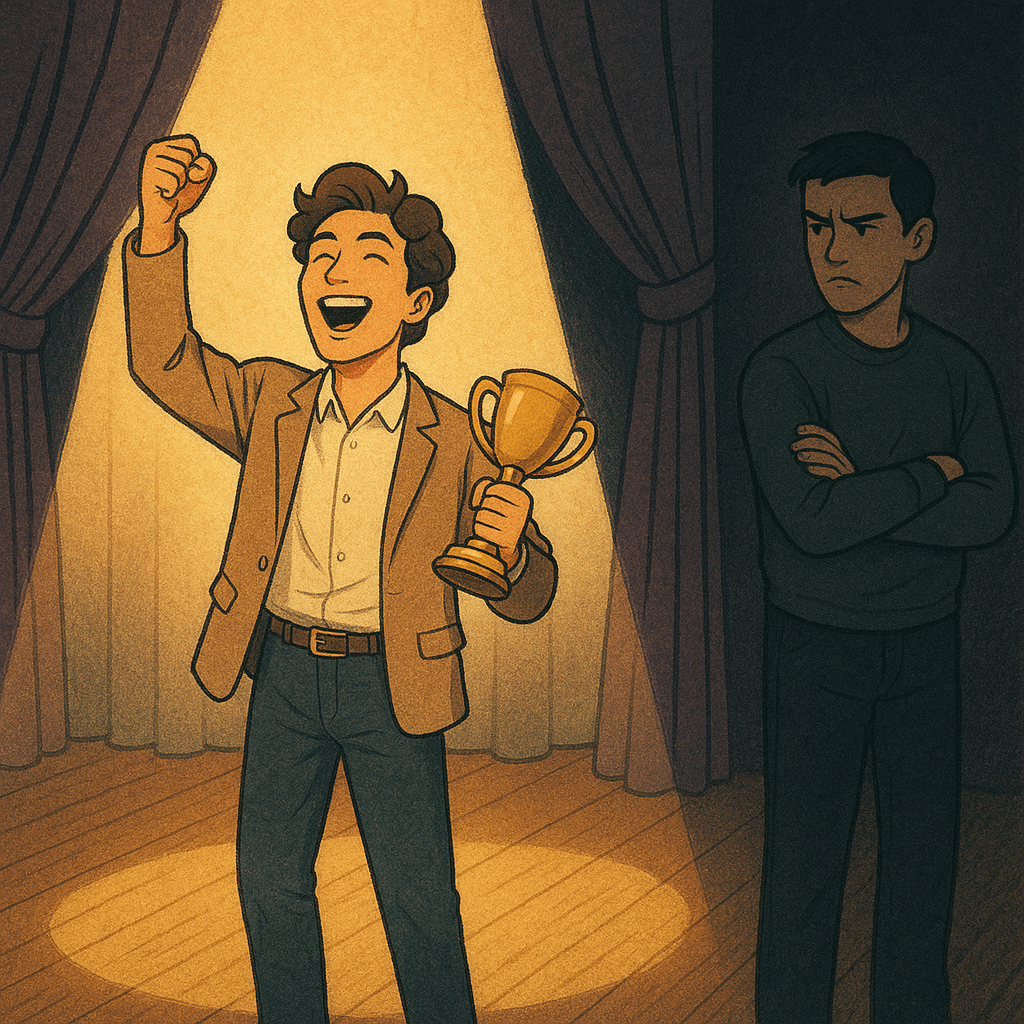
Those Who Envy Us and Those We Envy…

Envy is not just wanting what someone else has. According to psychoanalyst Melanie Klein, envy also involves a wish to destroy what the other person has. It isn’t only “I wish I had that,” but also “I wish you didn’t.” It carries a darker undertone. That’s why envy is rarely expressed openly in adulthood. Instead, it shows up as fake smiles, missed congratulations, or slowly fading friendships.

Recently, I noticed how muted people’s reactions were when someone in their circle achieved something significant. A major accomplishment was shared online, but the post stayed eerily quiet. Friends who’d known this person for years didn’t comment or congratulate them. The silence didn’t feel like apathy. It felt like emotional overload. As Adam Phillips says, envy is often triggered by people we compare ourselves to—not distant figures, but those closest to us.

According to Heinz Kohut, envy appears where self-esteem is fragile. Someone else’s success feels like our own failure. One person’s light casts another’s shadow. This is especially true among relatives, close friends, or people who started their journeys from similar places. When one rises, the other may feel left behind.

Clients in therapy rarely use the word “envy” directly. But they’ll say things like:

“I congratulated them, but it stung a little.”

“I don’t feel as close to them anymore.”

“I don’t know why, but I feel some distance.”

These often point to an old wound of not being seen, a sense of being left behind, or an internalised comparison.

Psychoanalyst Jessica Benjamin says that healthy bonding depends on both people in a relationship being able to express their subjective experience. Unfortunately, in many relationships, this symmetry collapses. One person shines, the other falls silent. That silence can slowly grow into distance—and even rupture.

Envy is not a bad emotion. But when it is denied or unacknowledged, it can quietly poison a relationship. In therapy, however, envy can open a door. Because it tells us what we value, what we long for, and in which areas we want to be recognised. Envy, therefore, is not a feeling to be judged—but to be understood.

As in so many childhood stories, envy often arises in the struggle for love. “My sibling got more attention” can resurface years later at work or in friendships. The praise someone else receives may echo a voice inside us that was never heard as a child.

Maybe that’s why the most meaningful congratulations are the heartfelt ones. Sometimes a message, a look, or an honest sentence is enough:

“I celebrate your success. I wish I could be a successful musician/painter/scientist/writer/entrepreneur/astronaut like you. Even if I didn’t follow that path, I’m proud to have a friend/sibling/cousin like you who did.”

And perhaps the most mature form of love is being able to recognise your own vulnerability in the face of someone else’s success—yet still speak up, still offer congratulations, still share in their joy.

When we envy someone’s success, our hope should be to notice that feeling, regulate it, and better yet, grow from it.

Instead of staying silent in the face of a musician we envy, let’s celebrate them—and practise more ourselves.

Or that business venture you always dreamed of? Let your friend’s success inspire you, and take your own steps forward.

We—especially in Central and East Asian cultures—are descendants of those who grow through mutual support.

All for one, and one for all.

π

Why I Don’t Believe in the Title ‘Child and Adolescent Therapist’

It’s written everywhere—on clinic doors, websites, LinkedIn bios:
“Child and Adolescent Therapist.”

But as someone deeply committed to developmental neuroscience and therapeutic integrity, I’ll say this clearly:

Children and adolescents are not the same.
And pretending they are does a disservice to both.

The Brain Doesn’t Lie

A child’s brain and a teenager’s brain are not simply younger or older versions of each other. They are fundamentally different organisms in terms of structure, function, and regulation.

1. Myelination: Speed of Thought
In early childhood, the brain’s executive functions are still under construction. Myelination—the process that speeds up neural communication—is slow and uneven. Children live in the world of now, with limited foresight or inhibition. They don’t just need therapy; they need your nervous system as an anchor.

In adolescence, the emotional brain (limbic system) races ahead, while the prefrontal cortex (rational control) lags behind. This creates the infamous teenage turbulence: intense emotion with minimal regulation. Here, the therapist becomes a boundary-holder, not a co-regulator.

2. Synaptic Pruning: Jungle vs. Garden
Children’s brains are like a lush jungle—bursting with synaptic connections. They’re wide open, absorbing everything. Therapy must be sensory-rich, structured, and playful.

Teenagers, however, are pruning the excess. Their brains are streamlining—deciding who they are, what they care about, and what gets cut. Therapy here must honour identity exploration, autonomy, and cognitive sophistication. Clay and metaphor won’t reach a defended 16-year-old struggling with existential dread.

3. Limbic–Cortical Integration: Emotions vs. Reason
Children externalise emotion. Their regulation is social—dependent on attachment and sensory cues. Therapy must include the body, breath, symbol, and parent.

Adolescents internalise and intellectualise. They test boundaries. They want a witness, not a playmate. They need someone who won’t flinch at their rage, sarcasm, or silence.

The Therapist Must Choose

Of course, some clinicians do shift masterfully between child and adolescent work. But it’s rare. The posture, method, and energy required for each is distinct. Personally?

I am a co-regulator. I work best when I can meet a child in their emotional rawness, build symbolic bridges, and offer a nervous system steadier than their own.

Does that mean I don’t work with teens? Not necessarily. But it does mean I choose with intention—not branding.

Let’s Be Honest About Specialisation

The title “Child and Adolescent Therapist” may serve paperwork and marketing. But in practice, we owe our clients more precision. Children don’t need someone who tolerates play. They need someone who thrives in it. Adolescents don’t need someone who enjoys deep talk. They need someone who can survive the storm of separation and self-definition.

If we are to be ethically aligned with brain development, we must be willing to say:
“I specialise in children.”
or
“I specialise in adolescents.”
or
“I know where my skill ends—and I refer with respect beyond it.”


This is not about superiority. It’s about specificity. Children and adolescents are both sacred, sensitive stages. They deserve therapists who speak their language—neurologically, emotionally, and relationally.

Let’s stop selling ourselves short with generic titles.
Let’s claim who we truly serve—and serve them with everything we’ve got.

π

Eight

I remember the minute
It was like a switch was flipped
I was just a kid who grew up strong enough
To pick this armour up
And suddenly it fit

God, that was so long ago, long ago, long ago
I was little, I was weak and perfectly naive
And I grew up too quick

Now you won’t see all that I have to lose
And all I’ve lost in the fight to protect it
I won’t let you in, I swore never again
I can’t afford, no, I refuse to be rejected

I want to break these bones ’til they’re better
I want to break them right and feel alive

You were wrong, you were wrong, you were wrong
My healing needed more than time

When I see fragile things, helpless things, broken things
I see the familiar

I was little, I was weak, I was perfect, too
Now I’m a broken mirror

But I can’t let you see all that I have to lose
All I’ve lost in the fight to protect it
I can’t let you in, I swore never again
I can’t afford to let myself be blindsided

I’m standing guard, I’m falling apart
And all I want is to trust you
Show me how to lay my sword down
For long enough to let you through

Here I am, pry me open
What do you want to know?
I’m just a kid who grew up scared enough
To hold the door shut
And bury my innocence
But here’s a map, here’s a shovel
Here’s my Achilles’ heel

I’m all in, palms out
I’m at your mercy now and I’m ready to begin
I am strong, I am strong, I am strong enough to let you in

I’ma shake the ground with all my might
And I will pull my whole heart up to the surface
For the innocent, for the vulnerable
And I’ll show up on the front lines with a purpose

And I’ll give all I have, I’ll give my blood, give my sweat
An ocean of tears will spill for what is broken

I’m shattered porcelain, glued back together again
Invincible like I’ve never been