Rule of Pi: Elimination of Friends (An introspective reflection)

Being a psychologist obviously brings introspective capabilities. I have came to realise my pattern of breaking bonds with people under three conditions;

  1. When they complain/make insuniating comments when one is late to a casual coffee date.
  2. When they choose to eat smelly animal products (chicken/beef or eggs) near me, when they clearly know I am a vegan. (They either do not have the empathy, or they do not respect me enough- either way; I feel ignored.)
  3. Luckily this happens very rarely- when people are more money oriented compared to our relationship. When they openly asks for the price they paid for coffee, a sandwich, or a ticket without giving you the time to pay back.

I choose to cut these people off directly without trying to tell them why it bothers me, because I believe these are all characteristic attitudes- to sum up, I dare bot continue relationships with stingy people.

Stingy with their time, food choices, and money.

There are always plenty of people in the world that will be generous in friendships.

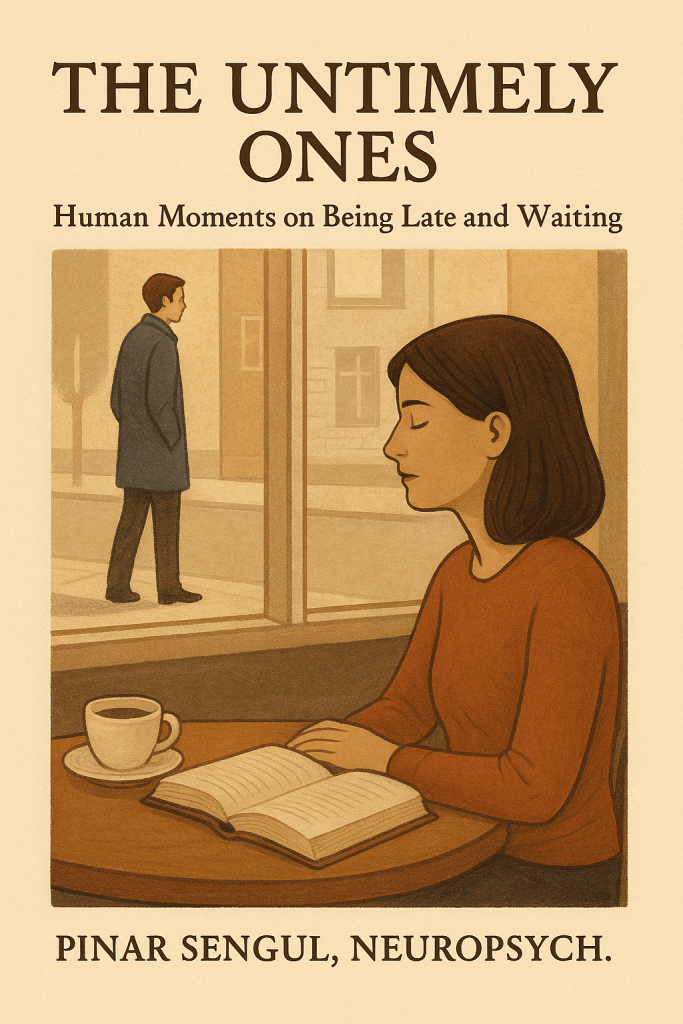
Those Who Don’t Arrive on Time –On Being Late and Waiting as a Human Experience

When someone is late, I don’t feel a knot in my chest.

On the contrary, time expands.

That gap becomes a rare opportunity to be with myself.

I order a coffee, jot down a few notes, take in the surroundings.

Until the person arrives, I remain with myself.

In that moment, it’s not the plan that matters, but presence.

And sometimes, the cancellation of a plan is a quiet restoration of the mind.

Being late, or cancelling a meeting, is not a rupture for me.

It’s simply a fragment in the natural rhythm of life.

And how that fragment is received often reveals a person’s inner posture.

I see these moments as an inner recalibration—a quiet attempt to align the uncertainty outside with the stillness within.

Because some moments are not relational, but deeply personal.

And to me, emotional maturity means leaning not on external order, but on inner balance.

Whoever comes, whatever happens…

The real question is—am I anchored in myself?

When meetings are delayed, I turn to my book, not my watch.

I don’t see waiting as emptiness, but as spaciousness.

I order a coffee, observe the world, return to my breath.

Because someone not showing up doesn’t mean I lose my sense of being.

Trying to fit life into precise minutes is like trying to control it politely.

But time is not our servant.

No matter how carefully we plan, the road sometimes stretches, the heart sometimes pauses, and sometimes—nothing happens at all.

And that, too, is part of life.

Cancellations…

I no longer hear “I can’t make it” as a rejection, but as a form of honesty.

And instead of resenting it, I try to meet that honesty with shared spaciousness.

Creating space is not only a gift we offer others, but one we grant ourselves.

When someone doesn’t come, I get to choose how to spend that moment.

Going home becomes a gift to myself.

Or walking alone through a street, listening to whatever music I like—perhaps even dancing a little—can become more precious than any scheduled plan.

Sometimes I ask myself:

Does someone being late mean the whole relationship is invalid?

Does a cancelled meeting cancel out the love too?

The mind rushes to answer, but the heart takes its time.

And I’m learning to trust the rhythm of the heart.

Connecting with someone doesn’t just mean celebrating their presence—it also means holding space for their absence.

Not necessarily without being hurt,

but without turning that hurt into anger.

It’s not about staying silent instead of expressing,

but about speaking from the right place, at the right time.

Because connection is not built through perfectly timed moments,

but through how we hold space in imperfect ones.

And true love doesn’t need everything to be on time.

To welcome someone without resentment when they finally arrive,

To say, “Don’t worry, while I waited I also took care of some things,”

To respond to a cancellation not with cold distance, but with:

“Shall we plan another time instead?”

This is where the elegance of human relationship lives.

Sometimes love is expressed not by doing something,

but by choosing not to.

Not pressuring, not interrogating, not judging.

Reading a book while waiting,

Not sending five messages to cause panic,

But keeping your own inner space intact—so that there’s room for someone else too.

Because we breathe best in the relationships where we’re allowed space.

And perhaps the truest bonds are not built when everyone arrives on time,

but when each person is allowed their own timing.

Maybe this understanding begins in childhood—

those moments when no one came on time,

when we were left waiting, forgotten, postponed…

A part of us then learned:

“If they’re late, they must not love me.”

And as adults, that part still flinches.

It feels like being forgotten all over again.

But now, we can take that child’s hand and gently say:

“This time is not the same as last time.”

Creating space means softening—

for the other, and for the older stories within us.

Not every cancellation is abandonment.

Not every silence is disinterest.

Not every delay is rejection.

Perhaps adulthood truly begins when we can calm that child within us,

and still love…

even those who arrive late.

Because the deepest bonds are not built on perfect harmony,

but on the grace that survives disruption.

Someone cancels on me—I might feel disappointed.

But that doesn’t mean I must set fire to the connection.

Sometimes, waiting for someone even though they’re late

is the clearest sign of inner maturity.

Life rarely unfolds exactly as we plan.

And maturity is not about fixing every imperfection,

but about meeting some of them with calm acceptance.

A meeting falls through. Someone’s late. Someone doesn’t show up at all…

And still, we can remain centered.

Because sometimes, what defines a moment is not what happens,

but how we stand in it.

And maybe the wisest souls are not those who always arrive,

but those who know how to wait—

without turning waiting into judgment.

Those Who Envy Us and Those We Envy…

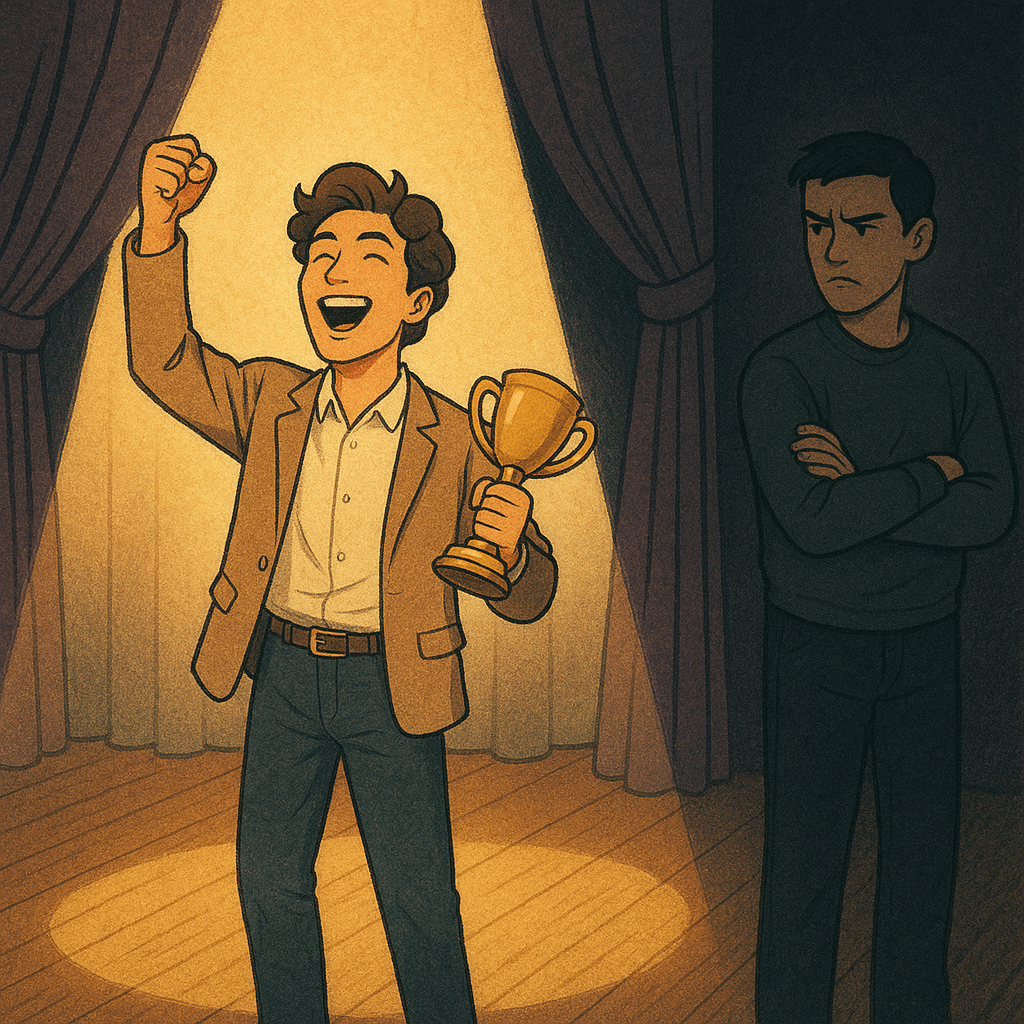
Envy is not just wanting what someone else has. According to psychoanalyst Melanie Klein, envy also involves a wish to destroy what the other person has. It isn’t only “I wish I had that,” but also “I wish you didn’t.” It carries a darker undertone. That’s why envy is rarely expressed openly in adulthood. Instead, it shows up as fake smiles, missed congratulations, or slowly fading friendships.

Recently, I noticed how muted people’s reactions were when someone in their circle achieved something significant. A major accomplishment was shared online, but the post stayed eerily quiet. Friends who’d known this person for years didn’t comment or congratulate them. The silence didn’t feel like apathy. It felt like emotional overload. As Adam Phillips says, envy is often triggered by people we compare ourselves to—not distant figures, but those closest to us.

According to Heinz Kohut, envy appears where self-esteem is fragile. Someone else’s success feels like our own failure. One person’s light casts another’s shadow. This is especially true among relatives, close friends, or people who started their journeys from similar places. When one rises, the other may feel left behind.

Clients in therapy rarely use the word “envy” directly. But they’ll say things like:

“I congratulated them, but it stung a little.”

“I don’t feel as close to them anymore.”

“I don’t know why, but I feel some distance.”

These often point to an old wound of not being seen, a sense of being left behind, or an internalised comparison.

Psychoanalyst Jessica Benjamin says that healthy bonding depends on both people in a relationship being able to express their subjective experience. Unfortunately, in many relationships, this symmetry collapses. One person shines, the other falls silent. That silence can slowly grow into distance—and even rupture.

Envy is not a bad emotion. But when it is denied or unacknowledged, it can quietly poison a relationship. In therapy, however, envy can open a door. Because it tells us what we value, what we long for, and in which areas we want to be recognised. Envy, therefore, is not a feeling to be judged—but to be understood.

As in so many childhood stories, envy often arises in the struggle for love. “My sibling got more attention” can resurface years later at work or in friendships. The praise someone else receives may echo a voice inside us that was never heard as a child.

Maybe that’s why the most meaningful congratulations are the heartfelt ones. Sometimes a message, a look, or an honest sentence is enough:

“I celebrate your success. I wish I could be a successful musician/painter/scientist/writer/entrepreneur/astronaut like you. Even if I didn’t follow that path, I’m proud to have a friend/sibling/cousin like you who did.”

And perhaps the most mature form of love is being able to recognise your own vulnerability in the face of someone else’s success—yet still speak up, still offer congratulations, still share in their joy.

When we envy someone’s success, our hope should be to notice that feeling, regulate it, and better yet, grow from it.

Instead of staying silent in the face of a musician we envy, let’s celebrate them—and practise more ourselves.

Or that business venture you always dreamed of? Let your friend’s success inspire you, and take your own steps forward.

We—especially in Central and East Asian cultures—are descendants of those who grow through mutual support.

All for one, and one for all.

π

Tested by Time: A Psychological Perspective on Being Late

Some people seem to place the entire weight of a relationship on a few minutes of delay. As if a slight shift in time could constitute a personal offense or moral failure. And yet, often, nothing is wrong. No crisis has occurred. Just a little change in rhythm.

People can be late. There might be traffic. An unexpected emotional wave. A sudden twist in the day. This is part of living. Time is not a rigid line. It is a presence that flows and bends with the pace of those inhabiting it. Still, when we assign absolute meaning to the clock, the smallest deviations begin to feel like betrayals. But in truth, flexibility is the root of trust, maturity, and meaningful connection.

When someone arrives late, I often see it as a quiet gift. I read. I revisit my notes. I answer long-forgotten messages or simply breathe. That space becomes a moment to meet myself, not a void waiting to be filled with irritation.

Others, however, interpret that same moment as a stage for punishment or criticism. But weren’t we meeting to soften life, to be present for one another? Not to police time as if it were a moral scale.

In human-centred spaces, whether a friendship, a therapeutic encounter, or a professional meeting, the intention behind presence speaks more than the punctuality of arrival. Holding someone hostage to the minute hand rarely nurtures depth. Often it reflects control, not care.

Virginia Satir once said that people grow not through perfection, but through acceptance. When we feel threatened, we become rigid. We hide in roles, defend boundaries, and lose our natural capacity to meet the moment as it is. Growth only becomes possible in the presence of emotional safety. And safety is built not through precision, but through compassion.

There is a quote of hers that continues to shape my understanding of relationships:

“I want to love you without clutching, appreciate you without judging, join you without invading, invite you without demanding, leave you without guilt, criticize you without blaming, and help you without insulting.”

Being late is not always a disregard. It can be a sign of an inner storm. Making space for that without judgment is, perhaps, the most human thing we can do. Those five minutes are not a test. But how we respond to them might be.

I no longer choose to work within frameworks that offer no room for human rhythm. I want to move with people who honour time not just by the clock, but by presence. People who understand that compassion is not the enemy of professionalism.

Because punctuality matters, yes.

But more than that, may we remain human.

How we treat time is how we treat people.

And the deepest form of respect is not control, but care.

The π

End Of An Era

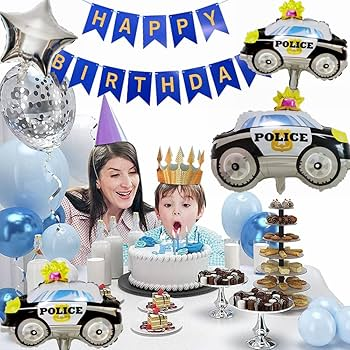
He chose to celebrate my birthday in the most unusual way.

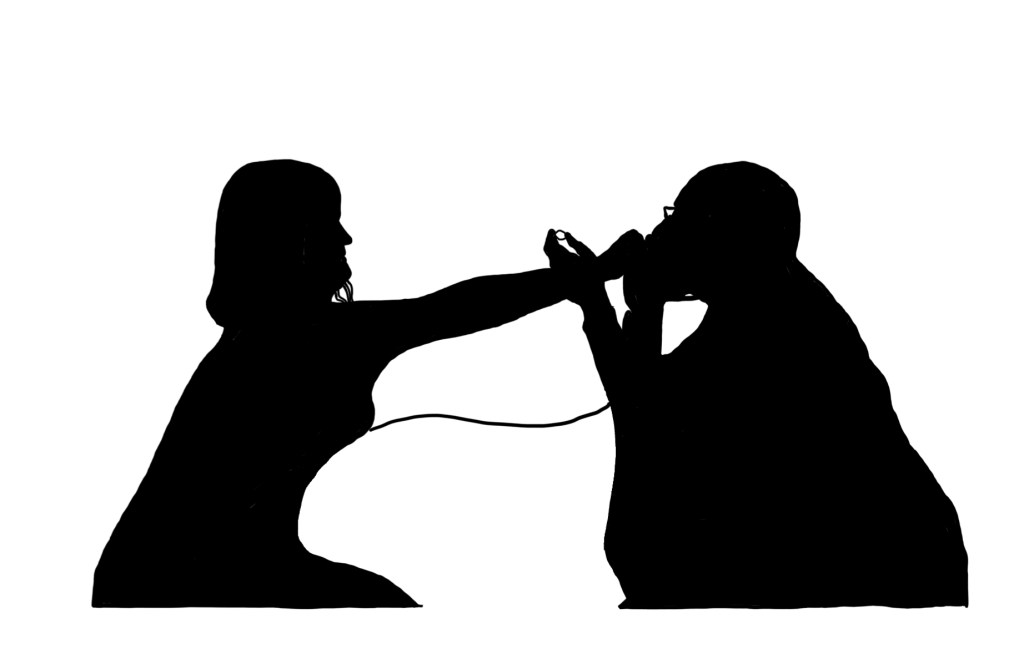
By making me hear his name through the phone—spoken by a cop—he helped me break the bond I had to him.

He did the lowest he could ever do.

There it was, an angelic mask was fallen off fully and it was made of glass.

Now no Japanese technique can mend it.

This is him.

Following his daddy’s commands at the age of 31.

It is pathetic, I am truly sorry for him.

He needs to obey his daddy to “fight” me.

I don’t care about him anymore.

I won’t fight his old parents.

They can’t race my life energy.

And I will enjoy anything that will follow-

The bad as well.

I admit- I enjoy winning every game I play in,

Or being dragged into those games by force.

I embrace all the chaos life brings.

Give the chaos to me,

And let me swallow it at once.

He knows that I can’t be defeated with brute force,

or enforcements.

Yet his father still can’t accept that

I am stronger than all of them.

Yet he still obeys his father,

Like a loyal German Shepherd-

can’t distinguish between the humanistic psychotherapist

and the positive punishment utiliser, cruel behaviourist scientist.

He has learned to obey.

I am sorry for him still.

Wish he was a Lion,

Independent and free to love what his heart truly loved.

I am sorry that his father did not let him love nor live.

Today, he gave me his best present ever-

the present of setting me free of,

unconditional love.

My heart is free of chains, again.

Yet he is chained with his parents’ desires all around.

PS. I wish he had chosen the civil way not the offensive way. Not that I am hurt, but that he’ll be hurt…

I still am sorry for his unfulfilled desires. But the war is accepted on the offences. Just like Atatürk did to Anzac soldiers, his losses will be respected in the land of my generous heart. 🖤

Tell his mama that sent his son from a gigantic love to a cruel war, his heart is now lying in the bosom of my past and in peace.

Mercury is in Retrograde, he said.

When I sent him hopeful songs, and he, depressive ones after our final break up, he reminded me that the mercury is in retrograde, so we shall not get back together.

Cause it would break us again.

I knew it better than him. It was me in the first place that taught him about the planets’ and the stars’ influence on human behaviour. Back then, he used to grin at me and tease me endlessly.

He said the same old words, everyone else had said before:

”How could you, Pi, a neuroscientist at mind and heart, can believe in Astrology? ..”

I did try to tell him why… All my reasons.

The constant conjunction of the behaviours of each zodiac sign. The statistics I have held with everyone I knew. Worked out most of the time.

I did my best to show him the beauty of the zodiac.

After him, I never tried to make anyone believe in it.

It took so much time and effort.

And now, whenever someone expresses disbelief, I change the subject-

To things they believe in: Like fashion and religions.

Anyhow,

When he put the fact of the Retrograde in my face,

I tried my best to make him let go of his orthodox belief in the planets!

I told him that we used to break up in retrogrades but not unite.

I was not really sure if I was totally honest.

I only wanted to have his long phone calls again,

Calls only,

As I was in London and he in Istanbul.

Long story short,

He was right.

The retrograde struck us again…

As it did hundreds of times before…

Only after a few days of talking to each other again,

A young girl knelt down to where I was lying on the grass in a park,

nicked my phone, and walked away….

Then we lost contact, he did not email me more than twice.

He was too lazy for emails or online meetings on a computer.

He let me go,

Once again.

He was right,

The mercury retrograde took him away once again.

What would have happened if the mercury had never moved back?

Would he have stayed?

Would he have committed?

Would he have been loy… no.

He was meant to be this way…

The Ring

Suddenly, the virgin is surrounding my existence again. Like he ever stopped.

It is due to this phones, reminding us of memories.

Photos from a year ago, where him and I finally got rings,

That had our names in it with the symbol of eternity-

Was on our fingers.

Was he really happy? I doubt so.

It was me-

Me and my 3 years craving for a symbol.

He could not resist my repetitions after that many years.

He was out of excuses and patience,

So he went and got us the rings-

The ones I chose.

He only cared about the colour.

He would not wear yellow gold nor the platinum.

He wanted the white gold only.

So I went with it.

After all, my dream was coming true:

Making us official.

I know how naive I sound.

But this is love.

Makes you even more naive.

As Shakespeare says,

“For to be wise and love exceeds man’s might.”

I was wise before (and after) him…

The ring did not last long.

He took it off whilst playing volleyball-

And most probably- whenever he was around girls he liked-

And near his mum- having a tantrum at me,

Just cause I was upset with his ”over the top” intimacy

with a girl from work.

She was one of his crushes.

One of the twenty I knew of.

She was asking if they could go alone to a concert-

without me.

I lashed out.

He lashed out- accusing me for lashing out.

He took off the ring

Threw it on the floor-

Shouted.

Near his mum…

That I was suffocating him with my jealousy.

Like I was wrong all along.

He was always right.

I should have kept silent.

Or he could play the dramatic act,

And show everyone that he was the victim.

Victim of a …

???

Lover???

I still can’t name it exactly.

Perhaps, he knows what it is.

He’s always ready to put the blame on me.

I was suffocating him with my love!! Yes here it is,

It was a gigantic love-

That did not give him the space to love back.

Cause I loved enough for the two of us.

I cared enough- or too much!

Anyways,

Now, somewhere

He is still complaining about me.

That I loved too much!

Things could have been much better if only…

I did not love that much..

If he could only feel

More masculine,

More giving,

More caring…

But I did it all…

He felt incompetent faced with my love,

As he said.

He wanted someone,

That loved just enough.

That cared just enough .

But not too much.

Someone not as motherly

and protective as I was.

Someone that was more human,

Less stable,

More histrionic,

Riskier.

He last said,

I was his safe harbour,

And he was meant to sail off…

I still can’t understand what he meant.

The Prologue of The Virgin Man

When we first met, he was a virgin. He told me this with a deep sense of embarrassment in his voice: “I’d understand if you didn’t want to date me, as I’ve never had a girlfriend before.”

I found this appealing. Why should he be embarrassed about being untouched, entirely pure, and all the more promising for a lasting bond? Now, nearly four years on, I see why he was so embarrassed. With those words, he meant that he could not commit to the first woman he fell in love with, as he needed to explore different kinds of women – one who spends a fortune on shopping, one who doesn’t love him as their other half, one who floods social media with endless selfies, one who parties and gets drunk, one who bamboozles, and one who is NOT ME.

Back then, I was innocent enough not to see this when he “confessed” his inexperience to me so shyly. He seemed certain I would leave him over it. Honestly, if I were to meet him now, or anyone else inexperienced or still a virgin, I’d leave immediately. But only after all the hard lessons – the foreshadowing of infidelity.

With my innocent mind at the time, I thought that was it: I’d found the purest man, aged 28, untainted by the touch of other women, in heart and body. He was clean, meant only for me. I felt exhilarated rather than wary when I learned he was untouched. And that was the beginning of all the heartache and tears that would follow in the years to come…

Love and Marriage in the Shadow of Infidelity: A Therapeutic Perspective.

Every year seems to chip away at our families, love, respect, and friendships

I was reminded of this while reading Alfred Adler, the renowned Austrian psychiatrist and psychologist of the 19th century.

In his book, Adler argues that if we feel interest and affection for someone, we must embody all the qualities that such interest demands. These include:

  • Honesty
  • Being a good friend
  • A sense of responsibility
  • Loyalty and trustworthiness

I believe that anyone who hasn’t managed to build a loving and committed relationship needs to recognise where they may have gone wrong.

Adler wrote this in 1913—111 years ago! His insights still resonate today.

Of course, problematic relationships have always existed, but back then, expert psychologists didn’t suggest things like, “Don’t interfere with each other; give each other space. Cheating before marriage is perfectly natural. Wedding stress can lead to infidelity, and these issues can be resolved and forgiven.”

Now, however, this is the prevailing attitude in both Europe and America. The year is 2024.

I’ve received couples therapy training from various institutes in America and Europe, and I continue to learn from different schools of thought.

Sadly, the situation isn’t promising for those who share Adler’s perspective.

We’re taught to tell clients who have been cheated on that reconciliation is possible and that peace can be restored.

As one of the few couples therapists who believes that remaining in a relationship marked by infidelity can harm both partners’ self-respect, I focus my sessions on empowering the betrayed partner.

In those moments, I no longer see a couple; I see someone who has been deceived and disrespected.

I help this person remember their worth and cultivate self-love and respect.

As for my training instructors, they tell couples that these situations can be mended. And from what I can see, they genuinely believe in this possibility.

If even deep-seated traumas can be healed, can the pain of a loved one turning their back on you, deceiving you, and developing feelings for someone else truly be resolved?

Can that knowledge simply be erased from memory? Can we accept it as normal?

According to the latest trends: yes.

They argue that instead of shouting at the child who spills milk, we should simply clean it up. That’s their analogy.

As I listen, I can’t help but chuckle wryly. However, I keep my “backward” thoughts to myself for fear they might disrupt their business.

After all, sharing my views might even make them feel unethical. Critiquing so-called experts often leads to backlash.

Yet I have long since dismissed them in my heart, guided by my respect for love. I know that attempting to correct their beliefs is futile.

Their underlying thought on infidelity among couples is simply this:

“If you didn’t value each other despite everything, you wouldn’t have come to me and spent so much money seeking my support.”

Yes, this is what they say amongst themselves—with a hint of mockery and a sense of superiority, forming a commercial coalition.

Now, to them, I’m one of their own.

In it for money, business, and exploiting people…

But I’m nothing like them.

I refuse to trample on people’s souls, their self-esteem, and most importantly…

Love.

Passion.

Family.

Money can always be earned.

My preference is to earn it for the greater good.

As long as people focus solely on their wallets, neither society, family, nor individuals will ever find peace.

In summary:

Don’t keep dishonest individuals in your life, especially those who betray you.

Spend your money not on those who cheat but on those who respect you.

Avoid seeking couples therapy to address infidelity…

No one deserves to be cheated on.

After all, there is no one else quite like you.

I wish for you to find someone who makes you feel special and unique.

Roy Lichtenstein, We Rose Up Slowly, 1964

Couples Therapist Pinar S.